
By Professor Cristiana Dilangkah-Navarez
University of San Fernando, Henry Banks College of the Social Sciences
In Association with the New Liverpool Daily
Cristiana Dilangkah-Navarez is a professor of human anthropology and culture at the University of San Fernando. The full article “In the Shadow of Excellence: An Analysis of Inequality in Slokais and the Factors of Development in the late 20th century” was published in the San Fernando Journal of Humanities available through the USF Scholarly Portal for students or through individual purchase of the Summer 2026 Issue
The term “shadow of excellence” is not of my own creation. It was developed by Claudia Zhao of the San Fernando Provincial Legislature in an unassuming debate on the state funding of a new multi-use development in Xinmen City. Her argument, which came from a place of self-interest, was that funding of the site, located next to an economically deprived area, would create a shadow of excellence as jobs would be created at the site as well as middle-class and upper-class residents who would spend at local businesses in the neighborhood of Kenwood Ferry. In the end, Claudia Zhao’s comments would go unnoticed by many as the development would be constructed anyway in 2010, however under a strictly private developer.
The term however reflects a sentiment of upper-class Slokasian society. That the wealth and prominence found in the decades after the Great War would lift the entire nation. In a 2020 survey by the Howard Prince Gonzalez Institute, among those with an annual income of over SM 2,000,000 (55,000 Sanctarian Marks) only 4.5% believed “inequality” was the biggest issue with “terrorism” being the most popular choice of 38.9% of those surveyed. Meanwhile among those who made less then SM 500,000 (13,500 Sanctarian Marks) the commonly accepted upper bound of the impoverished class, “inequality” was the largest single issue at 33.5% followed by “corruption” at 27.8%. This is unsurprising data as is various interviews with the wealthiest individuals, keywords used in regards to the question of inequality and inequity stress the burden for the poorest individuals to lift themselves up.
A Look at Kenwood Ferry
This assumption is not grounded in reality or history as poverty is often intergenerational. Looking at the Kenwood Ferry case again, the reasons for continued poverty become clear. Of the 5,650 residents of the Kenwood Ferry district of Xinmen, 55.6% make less then SM 500,000 and 17.5% make less then SM 250,000 which qualifies them for government assistance package regardless of job status or other conditions. These numbers from 2025 show little difference from prior census numbers with 1990 being the last census with a percentage change of more than 10%. Going beyond the data, let’s examine the geography of Kenwood Ferry.
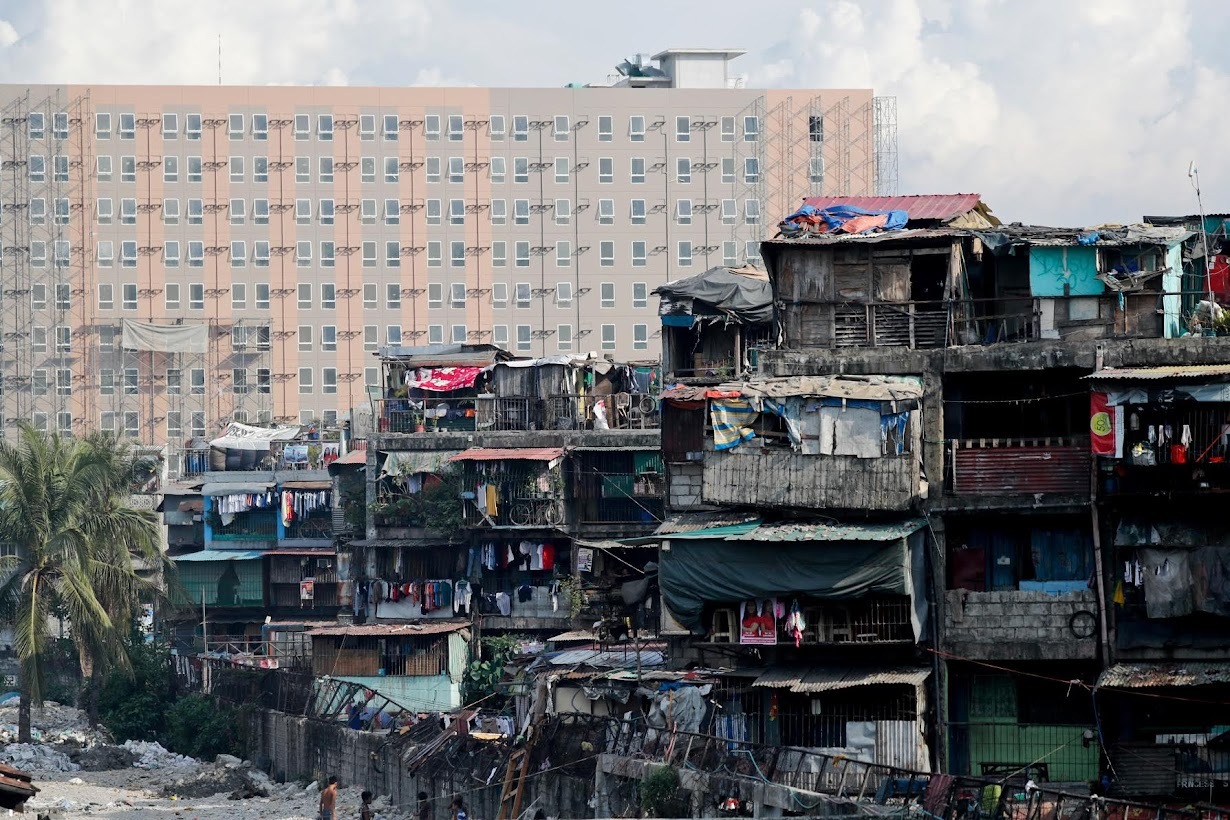
Located along the San Fernando River, the oldest buildings are factories with riverfront access to transport goods, mainly wholesale goods as classified by the 2025 Census. The second oldest properties are residential, particularly high density, low-rise slums areas.
One area along 15th Mark Road and Jiangte Street is home to around 800 residents and has been listed under one landlord since 1980, with 90% of residents making less then SM 500,000. The actual reality of this concerning, small one-room homes made of scrap metal and wood, dangerous self-made electrical and sewage lines. Flooding is a constant concern with standing water found in several low-lying areas, a breeding ground for tropical mosquito-borne diseases. The government classifies these structures as of 2020 under the new code SCSFH (Self-Constructed, Single Family Homes). Looking at national data, those living in SCSFH have lower life outcomes with lower rates of those with secondary school degrees, higher rates of infant mortality and most concerningly a majority being self-identified “Indigenous Slokasian”.
This is not just confidence, but rather proof of the failure of the Slokasian state. In a country, where economic development has risen and where the average income has doubled since 1985, there are leftovers and left-behinds. Indigenous Slokasians prior to the Costa era land policy which removed private property in most cases, rarely had documentation of their land. Instead, there was a sense of cultural understanding that one’s property would be respected by local community members and that land would be passed from father to son. This fact was changed little by the 1955 Land Act which removed private property and established large scale communal reserves.
However once the Great War ended and the Costa regime replaced, there was a sense among those who understood little of indigenous land customs that land would simply be returned to prior ownerships. This was not an issue for Ren, Costenos, Blancos and a majority of Mesitzo’s as often these groups had multi-generational ownership or lived under a landlord. Indigenous families without this documentation, their land was classified as “NPD’s” or “Not Permanently Developed” and thus ripe for new housing and industrial developments.
In the case of Kenwood Ferry, most indigenous people were of the Upper Aksanmani. A group which didn’t practice formalized land ownership. Factories were soon built in the region to support the expanding city of Xinmen and additionally new suburban developments, pricing out and driving out legacy residents. Kenwood Ferry however was low-lying and not suitable for the deep supports necessary for modern housing. Thus Aksanamani moved to what was then a small village in droves, settling in the unowned and unwanted plots. There were however issues as time went on. Residents lacked addresses as the various alleys and lanes of the slum development had no names on any registry and thus lacked access to necessary documentation for key government services. It took until the 2002 Land Reforms Act when street addresses where given to every permanent residency, a process which took almost 10 year’s that this issue was remedied.
The Education Gap
One could question how poverty lasts for generations. Yet the answer is in how society is designed. While public education is free, the quality of the education is lackluster compared to private education. In the case of Kenwood Ferry, students are enrolled in the Xinmen Township School District with Kenwood Primary School and Humberto Perez Secondary School being the automatic choices based on location. High achieving students may attend a magnet or trade secondary school, yet per 2024-2025 school year data only 3.8% of public school students in Kenwood Ferry attend one of these schools.
While there is always discussion of education as the great equalizer and there are stories of those rising out of poverty to become great scholars, business leaders or even the well-touted case of Joseph Chavez. This is not a common outcome, especially among those in extreme poverty. It can be hard for students to focus on schoolwork if they must take care of there younger siblings. It can be hard for students to succeed when there are few books or older adults able to support at home learning. It’s not that, education is being undervalued, a survey of parents in the Xinmen Township School District revealed that 75.5% of parents of families living in poverty valued “education as a priority” compared to 60.5% on average.
Data for the last 15 years has shown a gap in the standardized NCE exam taken in 11th Year of 400 to 550 points between public secondary and private secondary students. Lower scores, mean less prestigious, less well-funded and less well-connected colleges and technical institutes or even a lack of any post-secondary education. The NCE has been criticized as wealthier families and private school’s spend more time on preparing for the test, while public school students simply lack resources to support dedicated test prep. The NCE’s once viewed as an all-in one equalizer such as in the initial language of the 1995 NCE Development Act. The NCE has simply fueled a race to the top, high-quality UNL and private institutions such as the P6 Colleges continue to favor higher-income students and rarely reflect the national ethnic and relegious diversity, Slokaisans often pride themselves on.
The Literal Shadow of Excellence
For those who have never visited the Kenwood Ferry ward of Xinmen Township, one would assume based on all the data provided thusfar that Kenwood Ferry is entirely impoverished and simply one of those places. However that’s not true. Claudia Zhao’s development project which she stumped for in a long-forgotten speech from 2005 has open since 2012. Built by Rising Star Developments, a private company they didn’t have to abide by government mandates for affordbality or business. Instead the Xinmen Riverview Villages is a middle-class and upper-class gated community. Non-residents are welcome to enter but only through a narrow bridge which rises from the flatlands below. Just meters away and physically in the shadow of the development are the slums characteristic of the area. XRV is also an ethnic enclave as well as socioeconmic one, 75.4% of the population is Ren compared to just 17.9% in the entire Kenwood Ferry district. This is largely due to social dynamics surrounding large Ren families often moving together or in the case of the XRV, Rising Star Developments being owned by Liam Xiang-Jou. Xiang-Jou itself is a small clan from the Eastern Hills region of San Fernando Province which migrated to Xinmen City in the 1930s seeking work. Facing discrimination, the Xiang-Jou’s often lived close to each and formed economic and social bubbles.
Rising Star also owns 10 other retail and residential properties throught Xinmen Township each being predominantly Ren. This isn’t just a Xiang-Jou problem, or even a Ren problem forged by centuries of discrimination. Rather it’s a problem for all ethnic groups. Due to internal tension, workplace discrimination and the nature of hiring and doing business, ethnic groups tend to favor spending time with there group. Even in diverse cites such as San Fernando and New Liverpool, there are ethnic enclaves, especially among the middle and upper class. In fact it’s the working-class who are the most likely to live in proximity to those of other ethnic groups.
A Way Forward
Enterprising young men and women line the drive into the XRV development or walk around with boxes of candy and water hoping there peers with a sweet tooth stop for candy or salaryman grab a water after a long day at work in Xinmen. When I visited in 2025, I asked for the stories of those young people. They spoke of hardships which may surprise those of elite stature yet familiar to those who are economically deprived. I have detailed these in the “Stories in the Shadow” section of this paper. More importantly in the context of this section, I was warned by Riverview Villages residents, this young people poised a danger.
“Uneducated”
“Improperly-raised”
“A product of a negative culture”
This is not uncommon diction. There is a sense that if the positive role models where developed and parents where most present in young people’s lives and so on, that the issue of inequality would be solved. Instead there needs to be greater restructuring of land and housing policy. Neo-colonial systems of thinking need to be changed. The sense especially among those in the large urban centers of the San Fernando Island, that poverty is confined to the Outer Islands and Kaijan that inequality is provincial and not local needs to be changed. Hyper-local action needs to be taken in every township, ward and village with respect to cultural systems and norms. Inequality in Slokais has always existed, yet that doesn’t mean it has to be this way.
