
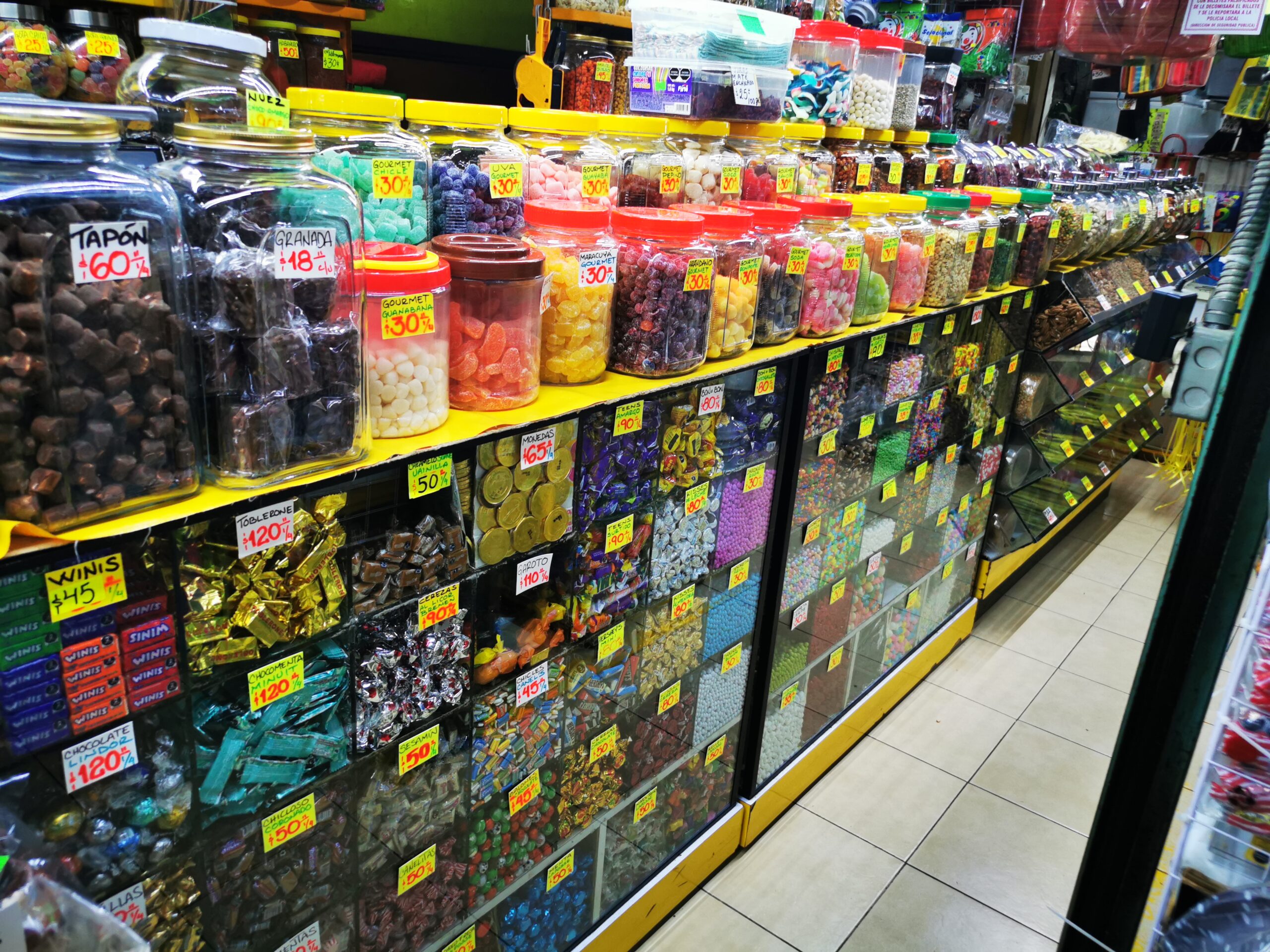
Every day for the last 160 years, the sweet smells of candy have wafted from Michella’s Best Candy Shop in San Fernando. The landscapes may have changed; the prices have increased exponentially, yet the customers keep coming. In the opinion of Lisa Alcante Bagnamiyan, descendant of the original Michella, after whom the shop takes its name, it’s the quality of service and genuine care. Just as employees start running the various machines and setting up the displays, Lisa tells me that they are well-trained on the specific taste and ingredients of each flavor.
“We aren’t training people to crank a nob, take change, and put on a smile; we are training experts,” Lisa says as we watch a young female employee cover freshly made fruit candy in the secret “Especial” chili dust. Customers can get in the chili mixture, plain or coated in thin layers of chocolate and vanilla.
Michella Bangamiyan was an indigenous Pimyan woman who came to San Fernando in 1859 to sell her family’s fruit at a bigger market. After several years of less-than-favorable margins and fruit turning bad. Michella realized she needed a way to preserve fruit longer. Drying fruit had been a traditional Pimyan practice for centuries, yet it was often bland and was mainly used to sweeten rich foods or as a special delicacy. Additionally, much of San Fernando at the time was still sugarcane farms, and thus sugar and sugarcane could be easily bought. These two things soon came together, and in 1863 the first “fruta cristalizada” or “crystal fruit” was added to Michella’s original market stall. It became popular quickly, standing out from much of the standard street fair of the day, as fruit and vegetable markets were associated with poor hygiene and unsophisticated farmers. By 1866, Michella had made enough money to buy a small plot on Orange Street near Quaysway, a then working-class neighborhood which had become a destination for those from rural provinces. From there, a tradition was born, with the business passing through the Bangamiyan family ever since.
The store finally opens at 8:30am and the first walk-in customers come in. It’s mostly gift orders: a tray of candied fruits and nuts for the business lunch, a box of chocolates for a wealthy housewife. Office workers and car salesmen and women are the most common customers this time of day, especially on Orange Street, which, in the 160 years since Michella’s first opened, has become one of the financial centers. Instead of a small wooden storefront, Michella’s now sits on the bottom three floors of an office building.
Tourists also come in, less likely to be there than the office workers, but still reliable for business. Initially, Michella Bangamiyan had only the crystal fruit, yet over time she hired more and more workers from the mountain provinces of Colorado and Silverado. These workers brought with them recipes for Ais kaching, crushed ice with coconut syrup and fruit. Michella was a skeptic; the popular dessert only worked in areas near the icy peaks of the Sierra Blancos and Silverado Mountains, as ice couldn’t be kept cold easily. Yet as more and more rural migrants arrived in San Fernando looking for a taste of their home communities, Michella made a large investment in a proper refrigeration system. Taking big risks has always been the brand, according to Lisa Alacante.
“We are always looking for innovations from everywhere. At our offsite facility, we have a whole department focused on chasing the newest trends in sweets,” Alicante says as she points to a large soda machine.
“That’s Michella’s Mixer; there are over 1 million possible syrup flavor combos which can be added to any ice cream or ais kaching”
Eventually, the business was passed down when Michella died in 1916. By then, profits were sky-high, and the business began to be slowly franchised, not as an entire store but rather as the goods they made. In the 1930s, a factory was built in the streetcar suburb of Saint Teresa, mass-producing candied fruit as well as sweet syrups to a nationwide audience. As the decades rolled on, however, the original store’s mission changed. Juan Costa’s National Reform Party had a choice supplier for all their sweet and candy needs, and encouraged all party members to buy from approved vendors. When Francisco Bangnamiyan refused to join the state-approved Corporation of Nut and Sweet Vendors and Distributors in 1956, the business was blacklisted. The police refused protection as vandals looted the store on several occasions. When a small fire broke out in 1958, residents had to help Fransiscio put it out by hand, leaving much of the original store in ruin.
Yet, Michella’s refused to move. People needed sweets more than ever in trying times throughout history. A lollipop to suck on for the young child whose Drywall Ball just lost, an ice cream for the laid-off salaryman to cry into as he wonders what to tell his kids. Sweets have always been an important part of Slokasian life in that way. The store was rebuilt. Even as the Great War brought tanks and columns down Orange Street, children still ran around to grab candy. Even when employees couldn’t go home, as there was no home left, Fransisco continued to pay them and allowed them to sleep on the floor.
Now, Michella’s little candy store has become a trusted brand. There’s very little in terms of TV or online advertisements, even in an age where the Slokaisan culture has become uniquely saturated with it. Word of mouth, tradition, and a willingness to put customers first are what keep them in business. For example, when the Second Kaijan War in 2007 caused a coconut milk shortage, the store refused to pass the extra cost on to customers when milk was used in products. In 2011, as a new office tower was planned to come up, Michella’s refused to move and instead worked themselves into the design. Life isn’t always sweet; a lot can be down, but there always will be Michella’s.
