
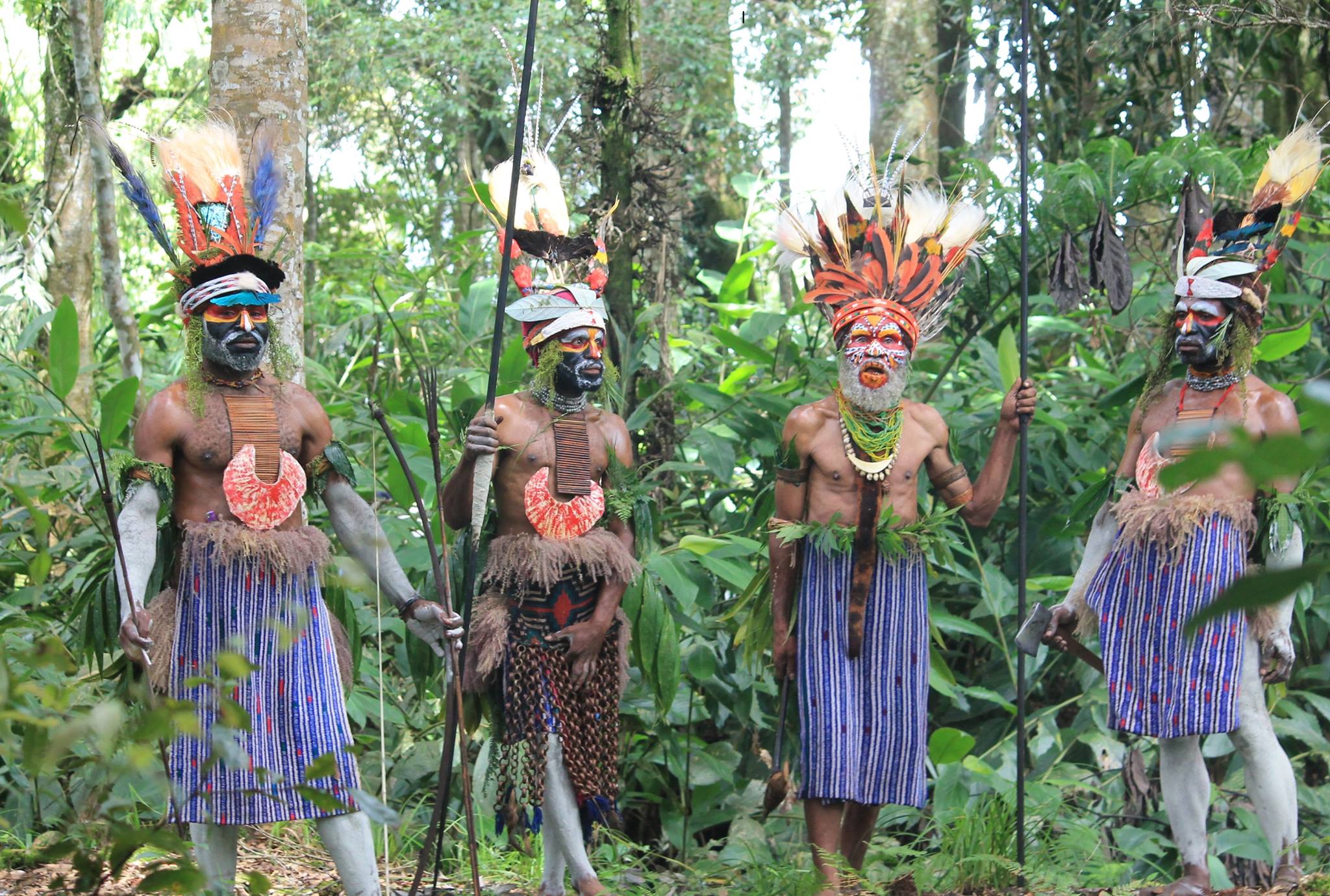
There are a few roads in the interior of the Kaying Ko’h, beyond the resorts along the coasts, where roads become seasonal and subject to mudslides and tree collapse. Additionally, the shape of the island, which separates the center by dense craggy mountains, means those living in the interior have little in common even with those living on the coast. In fact, the Koahian ethnic groups can be divided into the monolithic Koahian, who are primarily devout Catholics or Revivalists, or the inland Koahian groups who practice systems of spirit and ancestor worship dating back more than 20,000 years.
In the rainy season, road passage for vehicles is made impossible, although some always try. We pass over a delivery truck stuck in a large muddy spot between two large hills.
“Must be a new driver.” Charles Ope-Kambo says he is the director of the Kaying-Ko’h Heritage Project (KKHP), a state-funded non-profit tasked with managing anthropological research on the inland tribes.
“For decades, we had outsiders taking advantage,
centering themselves as the focus of research, not the people.”
Charles is referring to the national fascination with Koahans in the 90s and 2000s, as images of local tribesmen walking out of the dense jungle armed with just spears were broadcast to the world. Koahans are ethnically and linguistically outliers compared to even other nearby indigenous groups due to their movement to the region thousands of years ago. In colonial and imperial systems of hierarchies from the Kaijanese to the Costenoians, Koahan’s were viewed as even sub-human. Once the island was loaned to the Kingdom of Ambonar in the 18th century, the island’s people were linked to a mystical prophecy from the Book of Divine Communications, which described “people of the volcano, whose skin is burned by Ra-Gunna himself”. This led to several bands of Koahan’s isolating themselves inland. The isolation was largely respected by those familiar with the islands, as stories of travellers and explorers being met with rocks and arrows spread. However, attempts at logging and mining brought conflict. Today, however, relations have stabilized.
As a non-ethnic Koahanian my visit has to be approved by the Ministry of Tribal Affairs prior, a measure meant to reduce ethnic erasure and overtourism and development. Even Charles, who is Koahan himself, has only a certain level of clearance and is barred from venturing into certain areas without official approval. We land at a small helipad in Cao-Aki Town, a settlement of around 500 in a valley. Mainly, the town functions as a point of service and gathering for the Yapung ethnic group. Today, Charles Ope-Kambo is observing our recording of a traditional pre-harvest fest, which has never been documented by outsiders. We first enter the KKHP’s office, which includes several desks and centers for various social services. In a controversial move as of 2015, groups such as the Yapung are exempt from tax, as they don’t make tangible income or even traditionally participate in the economy. They can, however, access the benefits of citizens such as healthcare, education and voting. I shake several people’s hands, most being tribal members, grabbing the weekly educational packets.
Yapung have little need for money besides buying radio’s, housing materials and books from themselves. Money is often exchanged for excess food or beadwork, which are then sold in stores across the island, mainly to tourists. Despite popular assumptions, the Yapung are not lazy. It is culturally valued to be productive in some way. This often manifests in artwork, beadwork, or various community projects in addition to crop planting and hunting. Charles leads me to a large circular field
“The Yapung have been meeting here for many years before the outsiders’ arrival. They maintain grass length and make sure the space is always clean.”
There are already Yapung gathering, dressed in their equivalent of Sunday best. Several elders sit in carved chairs decorated with family and clan symbols. Beyond the simple identity of being Yapung, there are dozens of clans, each with their own name. For example, a prominent Yapung artist, Ampei Yapung-Loi-Kekla, which translates as “Ampei of the Lower Great Woods of the Yapung”.
Voting will occur here, surprisingly similar to the rest of the country. Ballots will be picked up during the month of November and must be returned before the date of the election. On the day of the election, an observer and election officials will collect the ballots from KKHP’s office, where ballots will be viewed and then submitted by hand. This is separate from a digital system used in much of the country, and means results will often come in very late, as they have to be physically checked again at the provincial election center in Santa Maria, the provincial capital. Most indigenous people in this area care little for the presidential election, but rather care more about the election for provincial governor and the tribal representative for all inland Koahans. In these races, party affiliation matters little with specific policy issues, such as tribal protections being the most valued. Maybe it’s this simple philosophy, which we need to approach political discourse.
